

How to Combine Shades Without Making a Room Look Busy
Choose texture laminated particle board shades by comparing them with your flooring, wall colour and furniture. Give the main shade a clear role, then introduce a supporting finish with a different pattern scale. Reviewing physical samples together helps you judge the complete combination before ordering.
Selecting each cabinet or wall panel separately can leave a room feeling disconnected. Planning the palette together connects different furniture pieces while allowing each one its own character.
Why Layered Interiors Are Relevant in 2026
Layered textures and warm palettes remain part of current interior design, adding depth through different surfaces and subtle colour changes.
For furniture, this can mean placing a detailed decorative board beside quieter surfaces. The aim is to create a relationship between finishes. Repeating the same strong pattern everywhere can remove the contrast that makes individual details noticeable.
Start With the Colours You Cannot Easily Change
Flooring, stone counters and existing doors should guide the shade selection. These surfaces usually remain in place longer than curtains or cushions.
Look at the background colour beneath the pattern. A beige design may lean yellow, pink or grey. Two finishes labelled beige can therefore look different when placed together.
Compare shortlisted boards beside the actual flooring and wall paint. A shared undertone can connect different patterns without requiring every surface to match exactly.
Give Each Shade a Specific Job
Assign the finishes to furniture areas before buying. This helps prevent a small catalogue sample from becoming an unexpectedly dominant feature across a large installation.
| Design Role | Where to Use It | Selection Approach |
|---|---|---|
| Main shade | Large cabinet fronts or storage runs | Choose a finish comfortable to view across a broad area |
| Supporting shade | Adjacent units or selected shutters | Keep a related background colour with a different pattern |
| Accent shade | A niche or limited feature panel | Use stronger detail where you want attention |
The right balance depends on the room. A patterned floor may call for quieter furniture, while plain surroundings can accommodate a more expressive cabinet finish.
Compare Pattern Scale Before Combining Designs
Pattern scale describes how large or closely spaced the visible details appear. Fine lines, broad marble effects and repeating shapes can produce very different results across a full panel.
Eddora’s Texture Laminated Particle Board collection displays designs including Taj Marble, Trellis, Line Marble and Golden Line. Compare actual samples rather than assuming the design name explains its appearance.
If one finish has prominent movement, pair it with a less active design. Request a larger panel image to check repetition across adjoining shutters.
Test the Combination Under Your Room Lighting
Daylight and artificial lighting can change how a shade appears. Surface texture also affects how light falls across the board.
Place samples upright when selecting shutters or vertical panels. Review a desk or tabletop sample horizontally. Check the combination during the day and with the room lights switched on.
View samples from the distance at which the furniture will normally be seen, then inspect the details closely.
Connect Adjoining Spaces Without Copying Every Finish
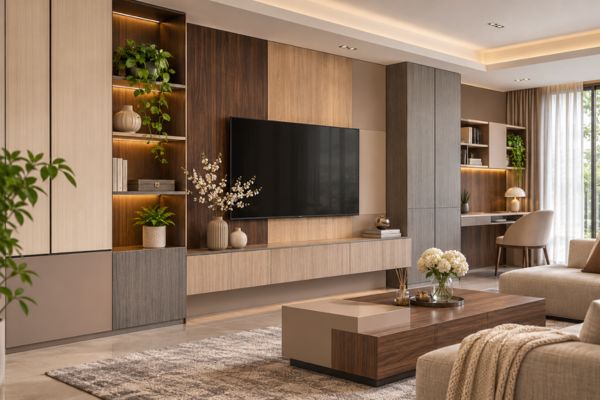
In an open living and dining area, you could repeat the main cabinet shade on a sideboard while giving a small display section a contrasting pattern. Similar background colours can keep the furniture connected.
Carry the same approach into nearby storage rather than adding another unrelated finish. A repeated handle colour or edge detail can also help.
Adapt the combination to your room’s light, existing surfaces and preferred level of contrast.
Record the Approved Combination Before Ordering
Keep an approval record showing design codes, finish references and the location of each board. Confirm board thickness and sheet dimensions separately from the decorative selection.
Ask about suitable edging and review the edge beside the board face. For directional patterns, agree on the cutting layout before fabrication. Check whether visible joints interrupt the design.
Texture alone does not establish scratch resistance, moisture suitability or cleaning requirements. Request product information for the intended application, then confirm quantities and delivery timing.
Conclusion
Choosing texture laminated particle board shades works best as a complete room decision. Coordinated undertones, varied pattern sizes and realistic lighting checks help create layered interiors with a clear visual connection. Eddora Particle LLP in Morbi, Gujarat, offers texture shade options for furniture and interior projects. Share your shortlisted designs and furniture plan to discuss suitable products, current availability and ordering requirements.
Buyer Intent FAQs
Contact Eddora Particle LLP in Morbi with your application and delivery location. Request the latest texture shade collection and confirm specifications before selecting material.
Ask about sample availability for your shortlisted designs. Compare samples together at the project site and keep the approved references for ordering and installation.
Start with a shared background colour, then vary pattern size or intensity. Review both finishes beside the flooring and wall paint before approving them.
Confirm edging options with the supplier. Compare colour, surface finish and thickness using physical samples, especially where edges will remain visible on finished furniture.
Have the furniture maker specify thickness according to panel dimensions, shelf spans, loads and fittings. The decorative shade does not determine the required board thickness.
Provide design codes, finish, board thickness, sheet dimensions, quantity and delivery location. Clarify packaging, transport arrangements and any cutting or edging requirements.
Confirm that the selected product suits each application. Matching appearance does not guarantee identical surface performance, so check the recommended use and care instructions.