

Plan a Workspace That Closes Away After Work
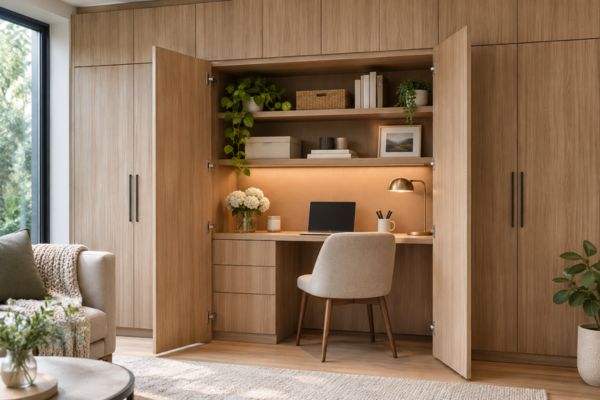
Interior Particle Board is a practical choice for concealed home offices built into cabinets, alcoves and fitted furniture units. It can be used for desk panels, shelves and storage compartments, creating an organised workspace within a compact area. Suitable board thickness, proper desk support and compatible door hardware allow the office to open for work and close neatly afterwards.
Using interior particle board for home office furniture gives laptops, documents and everyday accessories a dedicated place. A well-planned cabinet layout keeps work essentials accessible while helping the surrounding bedroom or living area remain comfortable for other daily activities.
Why Concealed Offices Fit Current Interior Design
Integrated furniture and hidden features are part of the 2026 move towards rooms that support several activities. A home office can follow this approach without becoming a complicated installation.
For example, a cabinet beside a living room bookshelf can contain a fixed desk, monitor and document shelf. Matching doors help the closed unit sit comfortably with nearby furniture. Opening the cabinet reveals a working area, while closing it creates a clear stopping point at the end of the day.
Choose the Location Before Choosing the Finish
A suitable workspace needs comfortable access, usable lighting and enough room for a chair. Check these conditions before selecting board colours.
A bedroom alcove may provide privacy for calls. A living room cabinet may be convenient for occasional work but less suitable beside a television. A passage needs enough clearance for people to move past the occupied desk.
Mark the proposed furniture outline on the floor. Test the chair position with the doors open. Include space for knees, feet and the monitor, rather than planning around a laptop alone. Check nearby walls for dampness before installation.
Match the Board Surface to Everyday Use
Pre laminated particle board has a decorative surface applied before fabrication. It can help coordinate cabinet fronts, internal shelves and desk panels.
Choose the finish using a physical sample under the room’s actual lighting. A matte surface may reduce distracting reflections, but matte does not automatically mean fingerprint resistant or scratchproof. Ask for the selected surface’s performance and cleaning information.
Consider how the cabinet looks when open, too. A lighter internal finish can contrast with darker external doors. Keep wood grain direction consistent across adjoining fronts if the design needs a continuous appearance.
Specify Doors and Hardware Together
Hinged doors need clear opening space. Sliding doors may leave part of the cabinet covered. Pocket doors move into dedicated side compartments, which must be included in the furniture dimensions.
Choose the opening method before finalising panel sizes. The hardware supplier should confirm permitted door dimensions, thickness and weight, along with fixing requirements.
Avoid choosing oversized shutters simply because the board sheet allows them. A furniture maker should check the complete assembly, including hinges or tracks, cabinet anchoring and access for later adjustments. Doors should remain clear of the working position.
Give the Desk Proper Support
A desk must support equipment and normal use without excessive bending. Board thickness alone cannot establish a safe load. Span, support positions, board properties and the connection method all affect performance.
For a wide desk, discuss intermediate supports or a suitable frame with the furniture maker. A folding worktop also needs hardware intended for that application. Ordinary cabinet hinges should not be treated as desk supports.
Protect exposed cut edges with suitable edging. Specify cable openings before fabrication so their positions do not interfere with supports or fittings.
Plan Power and Airflow Inside the Cabinet
List the devices that will stay inside the office. A monitor, printer and chargers need more planning than a laptop used occasionally.
Provide accessible sockets and cable routes that stay clear of moving doors. Have an electrician plan the electrical installation. Follow equipment manufacturers’ ventilation instructions, and avoid enclosing operating devices where heat can build up.
Task lighting should illuminate the desk without reflecting directly into the screen. Keep access available for replacing lights, reaching connections and cleaning behind equipment.
Conclusion
A hidden home office works best when the board, furniture layout and hardware are planned together. Interior particle board can support this design in suitable indoor conditions, with appropriate construction and protected edges. Eddora Particle LLP manufactures particle board products in Morbi, Gujarat. Share your furniture drawing and finish requirements to discuss available board options before ordering.
Buyer Intent FAQs
Contact Eddora Particle LLP with your project location, cabinet drawing and required quantity. Confirm available board types, finishes, sheet sizes and delivery terms before purchasing.
Ask your furniture maker to specify thickness using the desk span, expected load and support arrangement. Use the board’s technical information rather than assuming one thickness suits every desk.
Choose pre laminated board when you want a factory applied decorative surface. Plain board suits projects requiring a separately applied finish. Compare the complete fabrication requirements before ordering.
Ask about samples for the shortlisted designs. Check the actual colour and texture beside your existing furniture, then record the approved design code for the order.
Obtain the hardware supplier’s panel thickness, size and weight requirements. Have the furniture maker confirm compatibility with the selected board and the planned cabinet construction.
Provide board type, grade, thickness, sheet size, finish code, quantity and delivery location. Clarify whether cutting, edging, packaging or transport is included in the quoted scope.
Request technical information and any applicable emission test documentation for the exact product. Confirm its intended use and moisture limitations instead of relying on general product claims.