


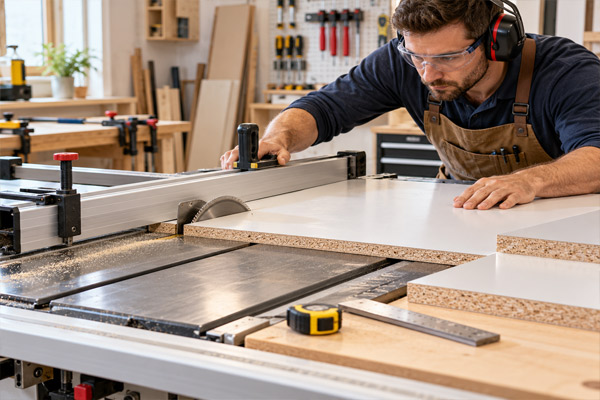
Get Cleaner Board Edges With the Right Blade and Support
To cut pre laminated particle board without chipping, use a sharp blade designed for coated panels, support the sheet properly and guide the saw steadily. For boards finished on both sides, a correctly adjusted scoring system can help protect both decorative surfaces.
Clean cutting matters because chipped edges can remain visible beside an edge band. Poor cuts also increase rework and material waste.
For wardrobes, cabinets and modular furniture, the goal is a straight, accurately sized panel with an intact surface. This guide explains the workshop checks that help achieve that result.
Why Does Pre Laminated Particle Board Chip During Cutting
Chipping happens when the decorative surface breaks away near the cut instead of being sliced cleanly. The risk increases where the blade teeth exit an unsupported face.
A blunt blade, vibration or uneven feeding can make the problem worse. Movement in the sheet or offcut can also damage the edge as the cut finishes.
Do not assume every chipped panel indicates poor board quality. Inspect the blade, machine setup and sheet support before rejecting the material. If damage continues after these checks, discuss the board condition with the supplier.
Choose a Blade Designed for Coated Panels
Use a blade specified for laminated particle board or similar coated panels. A general rough-cut timber blade may leave an unsuitable finish.
Check blade compatibility with the machine, including diameter, bore size and permitted speed. Tooth geometry matters alongside tooth count.
Carbide-tipped blades are commonly used for panel processing. Specialist diamond tooling may suit production workshops, but the choice depends on equipment and cutting volume.
Inspect the blade for damaged teeth and resin buildup. Disconnect the machine from power before checking or changing tooling. A sharp, clean blade should be the starting point for troubleshooting.
Support the Sheet and Guide the Cut
Place the board on a stable cutting surface that supports the panel and offcut without trapping the blade. Unsupported sections can bend or shift during cutting.
For a compatible handheld saw, a guide rail or secured straightedge helps maintain a consistent cutting line. Check that the guide cannot move and that clamps remain outside the blade path.
A sacrificial backing surface can support the underside where the cutting arrangement allows it. Set the cutting depth according to the saw manufacturer’s instructions.
Use dust extraction, eye protection and other protection specified for the equipment. Keep hands clear of the cutting path throughout the operation.
Make a Trial Cut and Inspect the Result
Use an offcut from the same board batch to check the setup. Feed the saw smoothly without forcing it or pausing unnecessarily.
Inspect the trial piece before cutting the remaining sheets.
| Cutting Result | What to Check |
| Chips on one face | Face orientation and support at the blade exit. |
| Chips on both faces | Blade condition, vibration and tooling suitability. |
| Burn marks | Blade cleanliness and feed conditions. |
| Uneven edge | Guide movement or blade alignment. |
| Damage near the end | Support beneath the remaining panel and offcut. |
Low-tack masking tape may help with marking and minor surface support. Test it first, as some finishes or protective films may react poorly. Tape cannot compensate for unsuitable tooling.
Position the Decorative Face for Your Saw
The correct face orientation depends on how the blade cuts. With many handheld circular saws, placing the preferred finished face down helps protect that face. Many table saw arrangements favour the preferred face facing up.
These are general starting points, not rules for every machine. Blade direction, scoring equipment and splinter guards can change the best arrangement.
Check the machine instructions and make a trial cut before processing full sheets.
When both faces will remain visible, inspect both surfaces. A clean upper edge does not prove that the underside is ready for assembly.
Use Scoring Equipment for Double Sided Panels
A scoring system makes a shallow cut in the decorative surface before the main blade completes the cut. Correct adjustment helps reduce breakout on double-sided panels.
On a panel saw, the scoring blade must match the main cutting path and suitable kerf width. Incorrect alignment can leave a step or damage the edge.
Some track saw systems also provide dedicated scoring functions or accessories. Use these according to their instructions.
Avoid improvised reverse-feed scoring passes with a standard saw. For repeated furniture production, suitable scoring equipment can reduce finishing work and rejected panels.
Plan Cutting and Edge Banding Together
Prepare a cutting list before processing the board. Include finished component dimensions, blade kerf, grain direction and any edge-band allowance required by the furniture drawing.
Label matching panels so wardrobe shutters and cabinet fronts keep the intended pattern direction.
Inspect cut edges before edge banding. The core should be even, without loose particles that affect bonding. Edge banding protects exposed edges, but it cannot restore large missing areas of the decorative face.
For projects in Ahmedabad, Morbi and other Gujarat locations, ask the supplier about available sheet dimensions and finishes before finalising the cutting layout.
Conclusion
Cleaner cuts begin with compatible tooling, stable support and a tested machine setup. Check both faces, plan edge banding early and stop to investigate repeated damage. These steps help furniture makers reduce waste and deliver better-looking components.
Frequently Asked Questions
Choose a blade recommended for coated panels and compatible with your saw. Confirm the tooth design and machine requirements with the tooling supplier.
Yes, with suitable tooling, stable support and accurate guidance. Test the arrangement on an offcut before cutting finished components.
Not always. Scoring becomes especially useful when both decorative faces need clean edges or when processing panels regularly.
Consider professional cutting if your workshop lacks suitable equipment. Confirm dimensions, edge quality, tolerances and service availability before ordering.
It may cover the exposed core edge, but surface chips can remain visible. Inspect cutting quality before accepting panels for assembly.
Provide thickness, finish, sheet quantity, component sizes, grain direction and delivery location. Ask about matching edge-band options where needed.
Share your furniture application and processing requirements with Eddora Particle LLP in Morbi, Gujarat. Confirm available board specifications and request suitable samples before purchasing.