

Match Your Wardrobe Board to Shelf Loads and Door Sizes
Choose particle board for a wardrobe by checking the board grade, shelf span, expected load, shutter dimensions and hardware compatibility. A decorative finish alone cannot tell you how a panel will perform. Proper support, protected edges and suitable hinges help wardrobe furniture work well over time.
A wardrobe shelf holding folded shirts faces different demands from a tall shutter opened several times daily. Treating both parts the same can lead to sagging shelves, loose fittings or doors that become difficult to align.
This guide focuses on those practical differences so homeowners, interior designers and furniture makers can order boards with clearer specifications.
Plan Your Storage Before Selecting the Board
Start with what the wardrobe needs to hold. Folded clothes, hanging garments, suitcases and accessories need different compartment layouts.
Wide shelves may look attractive in a drawing, but they need more support than shorter shelves. Heavy storage should have a suitable compartment rather than being placed wherever space remains.
Before requesting a quotation, prepare:
- Wardrobe height, width and depth
- Shelf widths between supports
- Expected contents of each compartment
- Hinged or sliding shutter design
- Required finish and approximate board quantity
This information helps the supplier understand your project instead of quoting only a sheet price.
Choose Shelf Thickness Along With Support
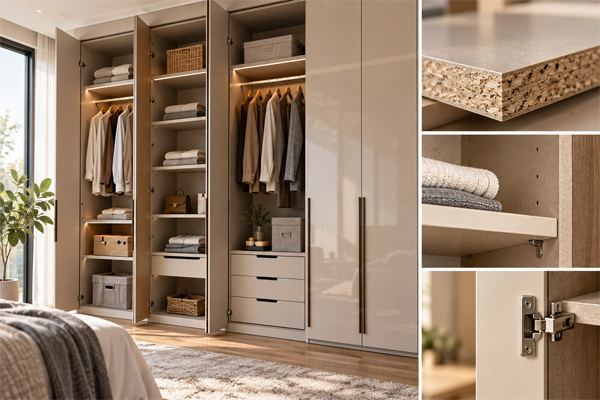
Particle board thickness should be selected together with the shelf span and expected load. A thicker board does not remove the need for good support.
An approximately 18 mm furniture board is a common starting point for wardrobe planning. However, the final choice needs confirmation against the selected board specifications and furniture design.
For example, a short shelf holding light clothing has different requirements from a wide shelf carrying luggage. Adding a vertical divider can shorten the unsupported span and reduce bending.
Ask the furniture maker to confirm the complete shelf arrangement. Avoid accepting a load capacity based only on thickness without considering shelf width, depth and fixing method.
Select Shutter Boards Around the Hardware
Wardrobe shutters need boards that suit the door dimensions and hardware system. Tall or wide shutters place greater demands on hinges and fixing points.
For hinged doors, hinge quantity and placement should follow the hardware manufacturer’s guidance for the door size and weight. Adding hinges without checking their specification does not guarantee a better result.
For sliding doors, confirm the track system’s permitted panel thickness, weight and dimensions before ordering boards.
Mirrors, handles and decorative additions increase the total shutter weight. Include these details when discussing the design so the board and hardware are selected together.
Compare Pre Laminated and Plain Particle Board
Pre laminated particle board comes with a factory-applied decorative surface. It can suit wardrobe projects where buyers want a consistent finish and fewer finishing steps.
Plain particle board requires a separate surface treatment. This gives the furniture maker more control over the finish, but adds material and processing requirements.
| Board Option | Buying Consideration |
| Pre laminated particle board | Confirm finish, shade, surface coverage and matching edge bands. |
| Plain particle board | Include the decorative surface and application cost. |
| High gloss finished board | Inspect reflections, visible marks and cleaning requirements. |
Compare finished wardrobe costs rather than the price of the board alone.
Make Finish Choices Practical
Woodgrain surfaces, matte colours and mixed finishes offer ways to create a modern wardrobe without complicated detailing.
A woodgrain exterior with a lighter interior can make storage compartments easier to inspect. Matte shutters create a softer appearance, while glossy surfaces reflect more light.
Check a physical sample under the room’s lighting before approving the finish. Catalogue photographs may show colours differently.
For matching shutters, confirm grain direction and cutting layout. In bulk projects, ask about shade consistency and keep an approved sample for comparison.
Protect Edges and Check Moisture Conditions
Cut particle board edges need suitable protection. Edge banding covers the exposed core, improves appearance and helps reduce moisture entry through vulnerable edges.
Specify edge protection for shelves, shutters and other exposed panels. Check that the edge band fits properly, with no open joints or lifting corners.
Standard interior particle board should be used in suitable dry conditions. Moisture-resistant grades are not automatically waterproof.
For homes in Ahmedabad, Morbi or elsewhere in Gujarat, inspect the installation wall for dampness before fitting the wardrobe. Fix leakage or seepage first. A decorative surface cannot solve a moisture problem behind the cabinet.
Request a Complete Wardrobe Board Quotation
A useful quotation should identify the board type, grade, thickness, sheet dimensions, finish and quantity. Delivery charges and applicable taxes should also be clear.
Ask for available technical information, including documented emission classifications where relevant. Do not assume every product has the same certification.
Eddora Particle LLP manufactures particle board products in Morbi, Gujarat. Share your wardrobe drawing, finish preference and delivery location with the team to discuss available options.
Confirm the cutting plan before purchasing. Sheet utilisation, edge bands and hardware can affect the final budget.
Conclusion
The right particle board for wardrobe shelves and shutters starts with the furniture design. Check shelf support, door weight, board grade and edge protection before choosing the colour. A clear specification helps buyers compare quotations and gives furniture makers a better basis for installation.
Frequently Asked Questions
Choose a furniture-grade board suited to the room conditions, shelf loads and shutter design. Ask the supplier to confirm the selected product specifications before ordering.
It can suit some shelf designs, but suitability depends on the unsupported span, load and fixing method. Ask your furniture maker to confirm support requirements.
Yes, when its specifications suit both applications. Check shutter weight and hardware compatibility separately from shelf loading.
Pre laminated board can reduce surface finishing work. Confirm that the available designs, edge bands and processing requirements match your project.
Confirm panel dimensions, total door weight and permitted thickness with the sliding hardware supplier before selecting the board.
Ask about sample availability for your preferred finish. Approve the sample and confirm shade consistency before finalising the quantity.
Share the board quantity, required thickness, finish, wardrobe drawing and delivery location through the enquiry details on the Eddora Particle website.